
Pet Apparel Manufacturer for Matching Owner and Pet Collections
We manufacture pet apparel for brands — and we are one of the few factories that also runs the human piece. So an owner-and-pet matching collection is built from one brief, on one line, in one production run: one MOQ, one sampling round, one quality check, one shipment.

Custom Crossbody Pet Carrier Hoodies — 380 GSM Tech Fleece
Beyond matching apparel sets, we manufacture high-demand functional hybrid garments for pet lifestyle brands. Our custom pet carrier hoodie features an ergonomic diagonal crossbody sling that balances pet weight across your shoulder and back — with zero neck strain. Built from thick 380 GSM cotton fleece with a removable zip-out washable liner, safety collar clip, and half-zip stand collar.

Matching Owner and Pet Collections: One Factory for Both
Most brands solve a matching collection by splitting it across two suppliers — a garment factory for the human piece, a pet factory for the animal piece. That is where the programme usually breaks. Colour comes back different, two sampling rounds run in parallel, and the pair only looks like a pair once both arrive. We run both sides of the pair ourselves.
Why One Factory Beats Two
| Two suppliers | Both at Toohoo Custom | |
|---|---|---|
| Colour | Different fabric lots and different dye houses — the human piece and the pet piece come back visibly different shades. | Both pieces go through our own dyeing in the same facility, so colour is worked to one brief for the pair instead of being reconciled between two suppliers. |
| MOQ | Two minimums to clear before anything is produced. | The human and pet garment count as one design. |
| Sampling | Two sampling rounds, two sets of samples, two rounds of revisions — and no one checks that they match. | One round that produces both pieces together, so they are approved as a pair. |
| Production | Two production slots, two QC passes, two shipments that may arrive weeks apart. | One run on the same cut-and-sew line, one QC pass, one shipment. |
| Accountability | Each supplier is only responsible for its own half when the pair does not match. | One contact, one delivery date, one quality guarantee covering the pair. |
Fabric, Colour and Decoration Matching
The two pieces in a matching collection are not the same garment at two scales — the human piece might be a 380 gsm brushed fleece while the pet piece needs something the animal can actually move and shed in. So what we match is not the fabric, it is the appearance: the same artwork treatment, the same trim colour, and a print or embroidery layout that is re-mapped for a curved pet back rather than scaled down.

Sampling Both Pieces Together
One submission. Both pieces are sampled against the same approved colour and the same artwork file, so what you approve is the pair — not two approvals you have to reconcile later.
Re-mapped, not resized. A pet torso has no shoulder line. Chest print, crest and number positions are laid out again for the animal pattern; a shrunken human graphic never reads correctly.
Fit signed off on the animal side too. Openings, belly straps and where the lead attaches are confirmed at sampling, because those are the details a brand cannot fix after production.
Pet-Only Ranges
The matching collection is the flagship, not the whole factory. If your range is pet garments only — hoodies, tees, crewnecks, bandanas, harness covers — we build and produce that on its own, at the same minimums and on the same line.
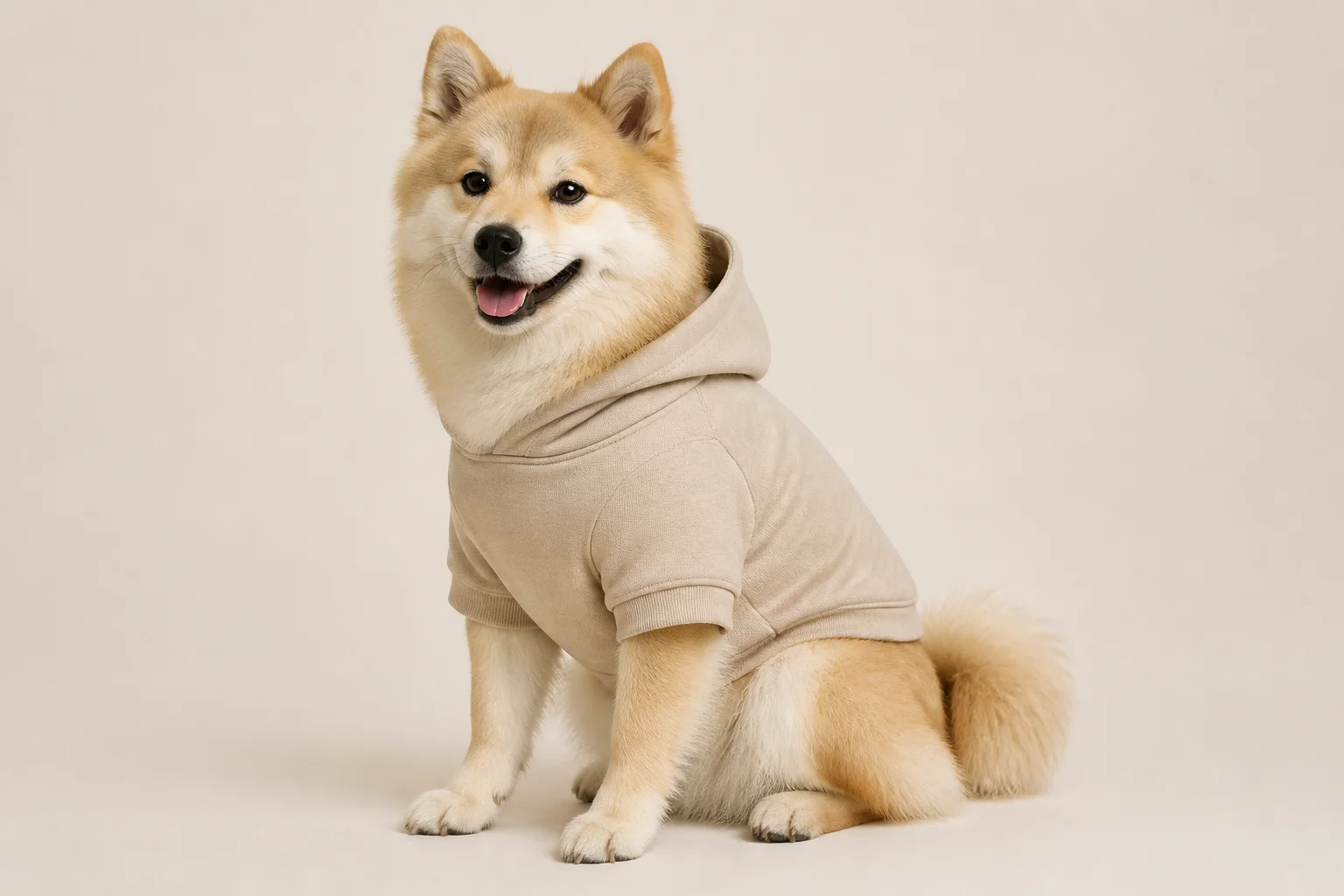
Custom Dog Hoodies
Pullover and zip hoodies cut to your own pattern or to a tech pack we develop with you. The hood, neck opening and front-leg cut are set for your target breeds, and the fabric weight is chosen for the garment rather than carried over from your human range. Screen printing, embroidery and applied decoration are re-mapped to the curved back panel instead of scaled down from the human piece. (Looking for human hoodies with an integrated pet sling pouch? See our custom pet carrier hoodie.)
Chat on WhatsApp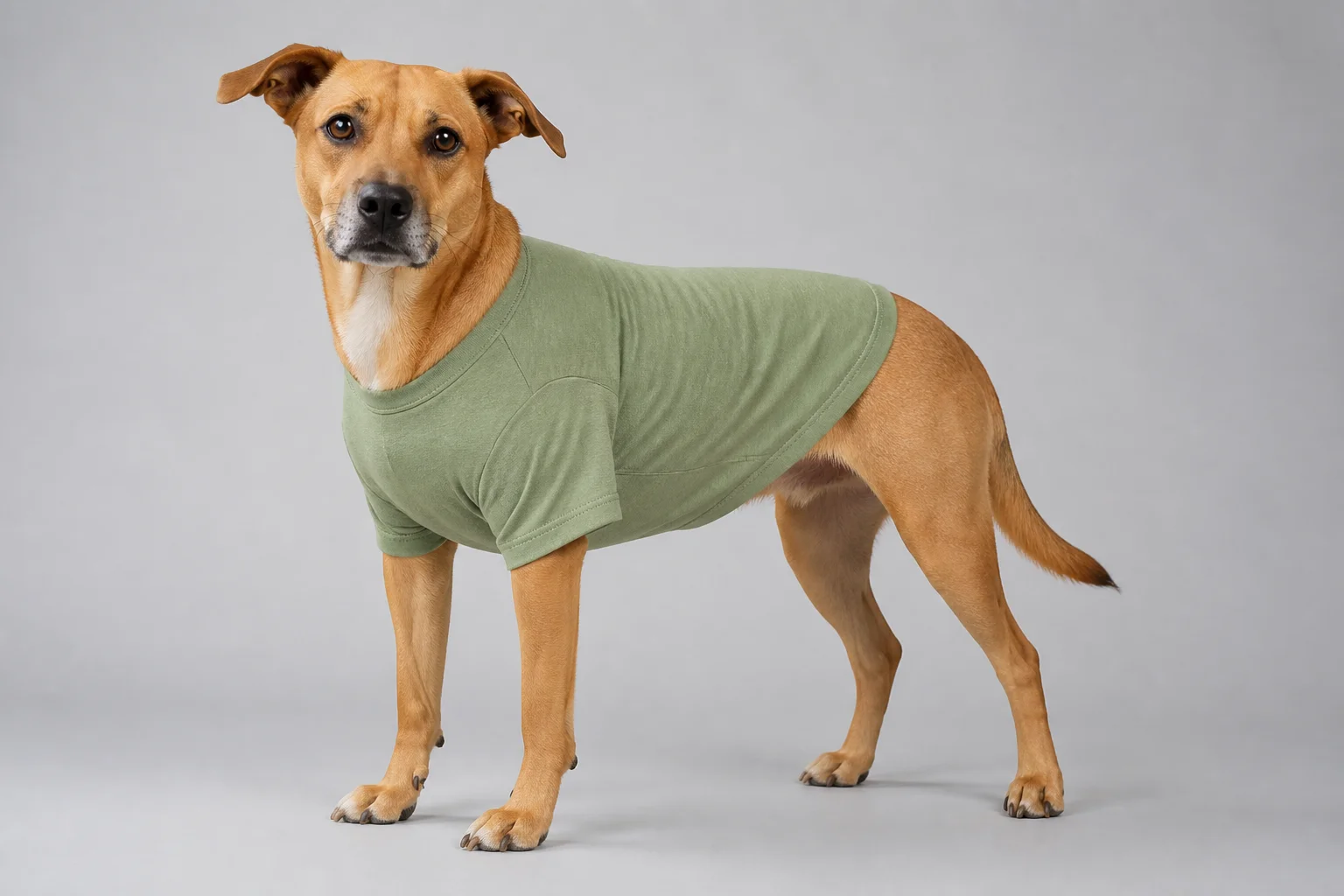
Custom Dog T-Shirts
Short-sleeve tees and tanks in combed cotton jersey or rib. The shaped neckline and front-leg openings keep the chest clear, and the neckline binding, sleeve finish and hem can be matched to the same colourway, trim and label you already use on the human piece — so the pet version reads as part of the collection rather than a separate product.
Chat on WhatsApp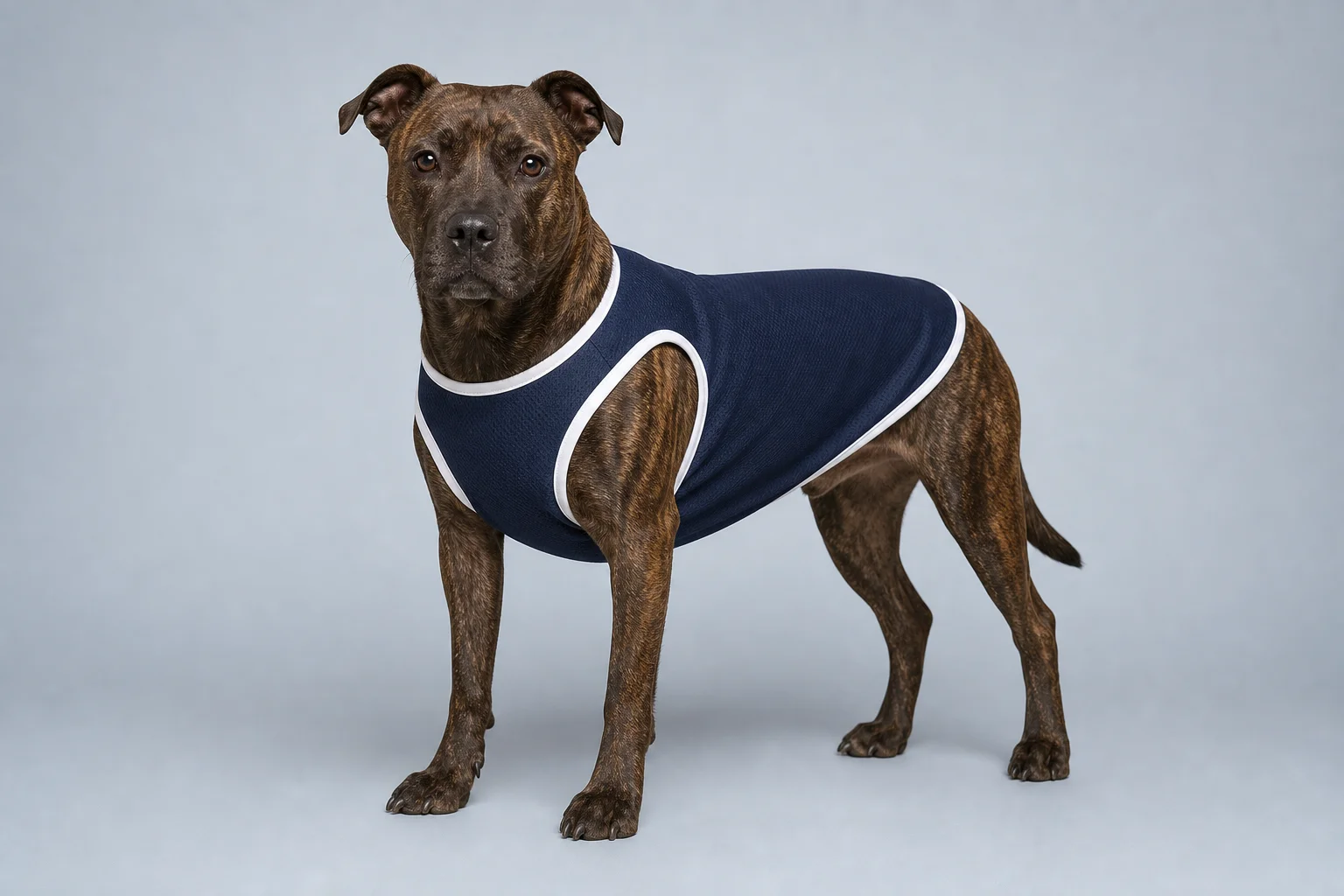
Custom Dog Jerseys
Sleeveless sports jerseys for club kits, fan sets and team programmes. Lightweight performance mesh with contrast binding at the neck and armholes, finished to MOQ 30 pcs per colour and design. Because a pet torso has no shoulder line, crest and number positions are re-mapped to the back panel rather than shrunk from the human shirt. Human club kits run on our jerseys manufacturing line.
Chat on WhatsAppSizing Across Breeds
A pet size range is not a scaled-down human range. It is built on three measurements — neck, chest girth and back length — and the ratios between them vary far more across breeds than they do across human sizes, so the size breaks have to be set for your target breeds rather than taken from a generic S–XL ladder.
Private Label and OEM/ODM
The whole range can run as private label with your own labels, hangtags and packaging, or as OEM/ODM where you bring the artwork and we handle pattern, grading and finishing.
Extending an Existing Human Line Into Pet
If you already produce human apparel and want a pet version of it, you are the easiest customer we have — because you are not adding a supplier, you are adding one pattern to a line we already run. This is also the most common way a matching collection actually starts.
Reusing Your Existing Tech Pack
Your existing specification does most of the work. Fabric, colour references, trims and decoration method are already defined — we add the animal pattern, the size ladder and the opening layout, then hand back a spec sheet that sits alongside the human one in your own system.
Keeping the Human Range Consistent
The pet piece has to slot into a range you already sell: same label placement, same hangtag system, same colour names, same packaging standard — so the pet version reads as a line extension on shelf, not as a separate product from a separate factory.
Streetwear Programs: Hoodies, Tees and Crewnecks
Streetwear buyers are not shopping for “dog clothes”. They are shopping for a drop — and the pet piece has to survive the same art direction review as the human piece. Oversized fit, heavy fleece hand-feel, print placement that reads at both scales.

Oversized Fits and Drop-Ready Runs
A matching hoodie programme usually starts with the human silhouette and works backwards to the pet garment. That order matters: if the pet piece is designed first, the human fit ends up compromised to match a four-legged pattern. We grade the pair so the drop shoulder, cuff and hem proportions still read as one look at both scales. Human-only hoodie programmes run on our hoodie manufacturing line.
Decoration and Branding
Embroidery holds up to washing and reads as premium on fleece — the default for chest logos and left-sleeve marks.
Screen printing carries the graphic weight. On small pet panels the print area has to be re-laid out, not scaled down — a shrunken version of the human graphic never looks right.
Woven patches and applied decoration let you keep one artwork across both garments without re-cutting the print for a curved pet back.
Sports Programs: Club Kits and Fan Sets
Sports buyers ask different questions than streetwear buyers. They want shirt numbers that survive a season, club crests placed per competition rules, and a size range that covers the squad — plus the fan version that sells in the club shop.
Club and Team Kits
Club kits for pets follow the same construction logic as the human shirt: numbering, name and number sets, sleeve trim and crest placement. What changes is the pattern — a pet torso has no shoulder line, so crest and number positions are re-mapped rather than shrunk. Human club kits are produced on our jerseys manufacturing line.
Fan Sets
Fan versions are a lighter construction of the club kit for supporters’ animals — the version that sells in the club shop next to the squad kit, in the club’s colours and crest.
Pattern, Sizing and Technical Deliverables
This is the section that decides whether a brand trusts you with the category. Buyers ask about these three things before they ask about price — and they are what separates a factory that has actually produced pet garments from one that says it can.
Pet Size Charts and Grading
Three measurements drive the size breaks — neck circumference, chest girth behind the front legs, and back length from the base of the neck to the tail. Those same three values are what you publish on the retail size chart, so the chart your buyer reads is the chart the pattern was cut from. Match your target breeds to us at enquiry stage and we will come back on which size breaks the range should carry.

Hardware, Openings and Construction
Harness openings. Whether the garment sits under or over a walking harness decides where the opening goes — and that decision has to happen at pattern stage, not at finishing.
Adjustable straps. Belly straps and chest adjustments are what let one size cover a breed range, which is how a small brand avoids stocking nine sizes.
Leash points. Where the lead attaches, and whether the garment carries the load or simply covers the animal, changes the construction entirely.
Tech Packs and Spec Sheets
You bring artwork, we return a spec. Send a reference garment, a sketch or your existing human tech pack; we come back with the animal pattern, graded measurements and construction notes.
Both specs in one document set. For a matching collection you receive the human and pet specification side by side, referencing the same colour and artwork codes.
Fabric and colour recorded per run. Fabric selection is confirmed through fabric selection and recorded so a repeat order re-runs against the original reference.
Ready to Sparkle Your Brand?
Send us your design and get a custom quote.
- Reply in 12H
- MOQ 30 pcs
Materials, Testing and Compliance
Two questions decide whether a pet range can be sold into a retail channel: will the fabric survive the way pet garments get used, and can you produce the paperwork the buyer’s compliance team asks for.
Fabrics and Wash Performance
Fabrics for pets are chosen on different criteria than the human matching piece. The human garment can be a heavy cotton fleece; the pet garment usually cannot, because the animal has to move, regulate heat and be cleaned far more often. Wash durability matters more here than hand-feel — a pet garment that pills after five washes is a return, not a reorder.
Testing and Documentation
Retail channels increasingly ask for test and labelling documentation before a pet range is listed, and the scope depends on your target market and channel. Tell us where you are selling at enquiry stage and we will confirm what applies to your order before production starts.
Ordering: MOQ, Sampling, Lead Time and Reorders
Four numbers decide whether a pet range is viable for a small brand. Here is how we run them — and what changes when the range is a matching pair.
MOQ and Sampling
A minimum order quantity of 30 pieces per colour and design applies across the range. For a matching set we treat the human and pet garment as one design, which is what keeps a two-piece range inside a small brand’s first order. Both garments in the pair sit under the same quality guarantee.
Production, Lead Time and Reorders
Both garments run through the same cut-and-sew line, so the pair finishes together rather than in two shipments. Because a matching range shares one pattern set, a second colourway or a next-season print is a re-run rather than a new development — which is what makes the line viable at small quantities.
Packaging and Retail-Ready Delivery
A pet range that arrives as loose garments in a carton is not shelf-ready — and a matching collection that arrives in two deliveries is not a pair. This is the last step, and it is where a two-supplier setup usually fails visibly.

We handle packaging to your retail standard: your labels and hangtags, size and care labelling, folding or hanging to your requirement, and carton packing that separates sizes and colours the way your warehouse expects. For a matching collection the human and pet piece ship as one delivery against one packing list — so the pair reaches your warehouse together, not in two consignments.
Why Brands Source From Toohoo Custom
We are a custom apparel manufacturer running our own cut-and-sew line — not a trading company passing your brief to a third party. That is what makes a two-garment programme possible at all: the human and pet piece are cut, dyed, decorated and packed in the same building, so they can be made to match.
Frequently Asked Questions
These eleven questions also generate the page's FAQPage structured data and carry the long-tail queries.
Can you produce the owner and pet versions in the same production run?
Yes — that is the point of running both sides of the pair ourselves. Both garments go through the same cut-and-sew line, so they are produced together, quality-checked together and shipped in one delivery.
How do you guarantee the colour matches between the human piece and the pet piece?
Because both pieces are made in the same facility, colour is worked to one brief for the pair rather than reconciled between two suppliers, and decoration is matched the same way — one artwork file, re-laid out for the pet pattern instead of rescaled.
Do we pay two MOQs if we order both the human and the pet version?
No. The human and pet garment are treated as one design under our 30-piece minimum per colour and design, so one minimum covers the pair.
What is the minimum order quantity for custom pet clothing?
30 pieces per colour and design for the pet line, and the human and pet garment count as one design for a matching set.
How do you measure a dog for a matching hoodie?
Three measurements drive the whole range: neck circumference, chest girth behind the front legs, and back length from the base of the neck to the tail. The ratios between those three values define the size breaks — not a straight scale-down of the human pattern.
Do you make pet garments only, without the human piece?
Yes. Pet-only ranges are produced on the same line at the same minimums — the matching collection is our flagship, not a condition for working with us.
We already produce human apparel. What do you need from us?
Your existing tech pack does most of the work. We add the animal pattern, the size ladder and the opening layout, then return a pet spec sheet that sits alongside the human one in your own system.
Do you do private label and OEM/ODM for pet apparel?
Both. The range can run under your own labels, hangtags and packaging, or as OEM/ODM where you supply the artwork and we handle pattern, grading and finishing.
What decoration methods work on pet garments?
Embroidery, screen printing, woven patches and applied decoration all work, but the printable area is smaller and curved. Graphic layouts generally need re-laying out for the pet panel rather than resizing.
How long does sampling and production take?
Sampling is about 7 days for the pet line, and standard production is 14 days, with the full range landing between 7 and 21 days depending on complexity.
Can you supply sports clubs and streetwear brands?
Yes. Sports programmes run as club kits and fan versions; streetwear programmes run as hoodie, tee and crewneck matching sets. Both follow the same MOQ and sampling windows.